Sales pipeline: what is it, what are the stages and how do you build yours on WhatsApp?
A sales pipeline is the path from first contact to purchase, split into stages. See the stages, how to build yours on WhatsApp and how to measure each one.
Por CertuAI Team13 min readQuem responde pela empresa: Bernardo Villela

- A sales pipeline is the path from first contact to purchase, divided into stages, and fewer people remain at each stage.
- If you sell on WhatsApp, five stages are enough: new contact, qualified, proposal sent, negotiation and closed.
- The math for each stage is how many moved on divided by how many came in, and the stage with the worst result is the first one to fix.
Not for: Not for businesses that close the sale in the first message, like delivery with a fixed menu: there, what counts is response time and a clear menu, not stages.
It's 7 p.m. on a Friday. You try to close out the month and can't say how many quotes you sent. WhatsApp has 80 open conversations, half of them stalled since Tuesday, and you don't remember who asked for a discount and who just disappeared. You can feel sales slipping away. You just can't see where.
About CertuAI: CertuAI is an AI chatbot that answers a small business's WhatsApp 24/7: it replies to customers, books appointments and keeps every conversation in a built-in CRM. It is a Tech Provider on Meta's WhatsApp Business Platform. Paid plans start at US$ 99 a month, with no lock-in. In measurements from 30 Jul to 30 Sep 2026, the AI replied in 11.7 seconds at the median (38,908 replies). Create my agent
Want to see this working on your business's WhatsApp? Connect your WhatsApp and the AI learns from your conversations.
What is a sales funnel?
A sales funnel is the layout of the stages a customer goes through from first contact to purchase. Each stage has a clear condition for the contact to move forward, and at each one some people drop off. That's why the shape is wide at the top and narrow at the bottom.
The pipeline is not software or a closing technique. It is a way to organize what already happens in your business, so you know how many contacts are at each point and what each one needs to move forward. A pipeline is the list of people still waiting on you.
What are the stages of a sales funnel?
The classic split has three parts: top, middle and bottom. They describe how much the person already knows about the problem and about you.
| Part | What the person is doing | What you do |
|---|---|---|
| Top (discovery) | Realizes they have a problem and starts researching | Shows up where they search and answers the first question |
| Middle (consideration) | Compares ways to solve it and asks for information | Understands the case, shows how you solve it and sends the proposal |
| Bottom (decision) | Chooses who to buy from | Removes the last objection, agrees on price and timing and closes |
What are the sales funnel stages for a small business that sells on WhatsApp?
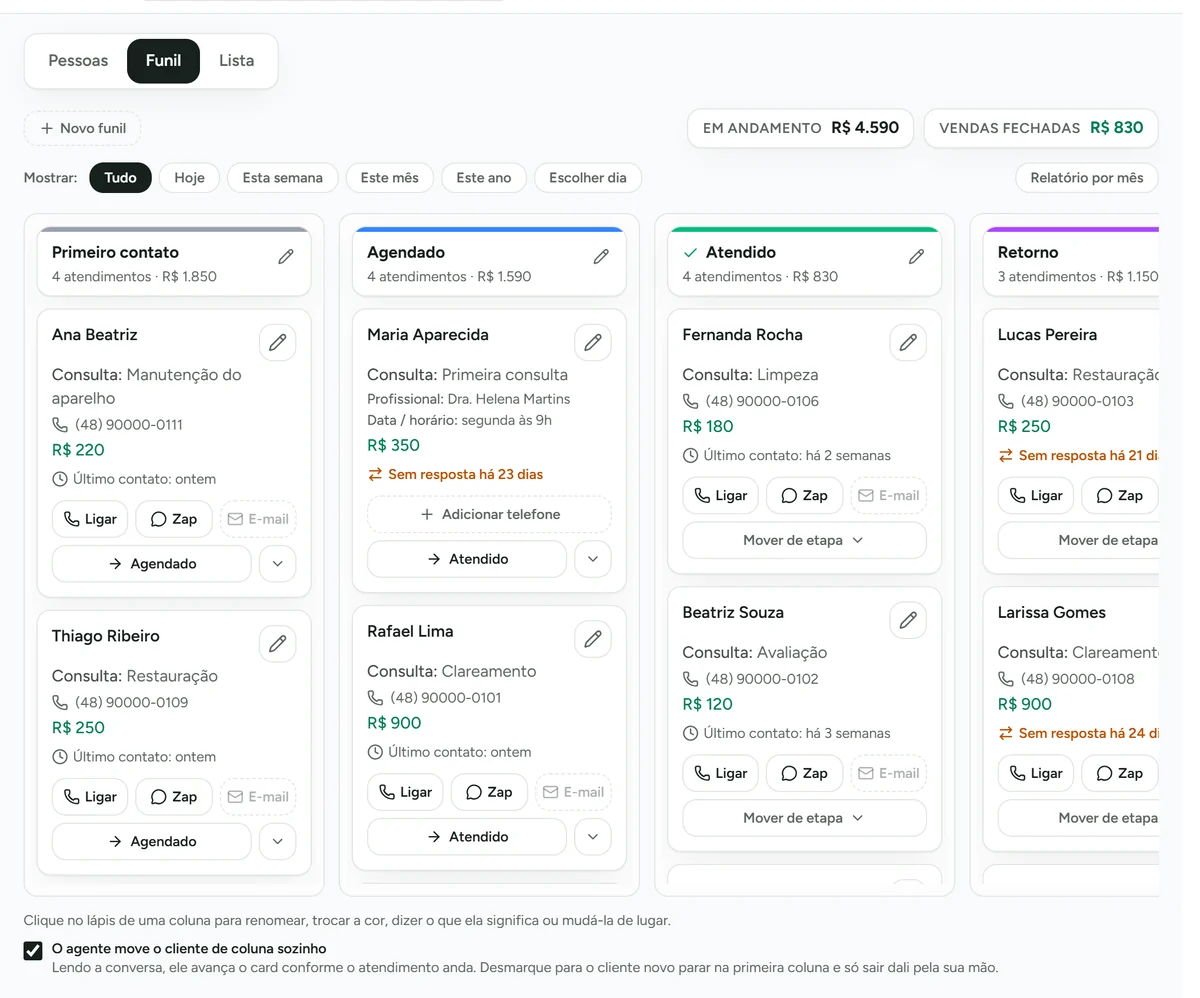
Day to day, top, middle and bottom become stages named after actions. A simple model that works for most businesses that serve customers by message:
- New contact. The person wrote for the first time.
- Qualified. You already know what they need and whether you can serve them.
- Proposal sent. The price or the quote went out.
- Negotiation. They replied to the proposal with a question, a request for a discount or a timeline.
- Closed. Won, when they paid or booked. Lost, when they said no or disappeared, with the reason noted.
How do you build a sales pipeline on WhatsApp, step by step?
- Write down the stages that already exist. Look at your last sales and note what happened between the first hello and the payment. Don't copy another company's funnel.
- Define what moves a contact to the next stage. A fact you can check in the conversation: they sent the address, got the quote, asked for the payment link.
- Put every conversation in a stage. A contact that isn't in any stage is a forgotten contact.
- Give each contact a next step with a date. Someone who got a proposal on Monday and didn't reply gets a message on Wednesday.
- Note the reason for each lost sale. Price, timing, went quiet, bought somewhere else. Within a few weeks the most common reason shows up.
- Look at the numbers once a week. How many came in, how many moved on from each stage and how many closed.
We saw a simple pipeline like this at a floor cleaning and polishing company in Rio de Janeiro. There, the stage that matters is the visit: floor work has no fixed price, and anyone who asks "how much does it cost?" needs to hear that the price comes at the visit. The AI follows the screening line the owner dictated and asks for the address, day and time. From Sep 23 to Oct 22, 2026, it handled 257 conversations and booked 18 on-site visits. In the CRM, 109 deals were opened, and 10 reached the won stage. See the full case.
What makes a contact move to another pipeline stage?
The pipeline only shows the truth if everyone on the team moves the contact for the same reason. The rule is to use a fact that shows up in the conversation, never an impression ("he seemed interested").
| Stage | Enters when | Leaves when | Standard next step |
|---|---|---|---|
| New contact | Wrote for the first time | You understood what they need | Reply within minutes, with a question |
| Qualified | Said what they want and you can serve it | Received a price or quote | Send the proposal the same day |
| Proposal sent | The price went out | Replied with a question, request or acceptance | Follow up in 1 to 2 days if no reply |
| Negotiation | Asked for a discount, a deadline or a change | Accepted or declined | Resolve the objection and propose a date |
| Closed won | Paid, signed or booked | Purchase delivered | After-sales and review request |
| Closed lost | Said no or disappeared after two follow-ups | Never (only comes back as a new contact) | Note the reason |
Quick test of the criteria: show five conversations to two people on the team and ask each one to name the stage. If they disagree on more than one, the rule is still vague. With a clear rule, no one on the team has to guess.
What messages should you use at each pipeline stage on WhatsApp?
Each stage calls for a type of message. Use these as templates; swap the name and the product for yours.
New contact: the first reply
Hi, Fernanda! Glad you reached out. So I can give you the right information: is this for you or for someone else?
Qualified: before sending the price
Got it, you need three nights in November, for two people. I'll send you the rate with the two room options, okay?
Proposal sent: the follow-up
Hi, Fernanda! Did you get a chance to look at the two options? If you'd like, I can hold the date for today while you decide.
Negotiation: when they ask for a discount
I understand. At that price I can keep everything if we book all three nights at once, or remove breakfast and lower the price. Which of the two makes more sense for you?
Closed lost: the last message
No problem, Fernanda, thanks for letting me know. If you change your mind or need another date, just message here.
Notice that the negotiation message offers two ways out instead of giving a discount outright. That protects the margin and hands the decision back to the customer.
How long can a contact stay at each stage?
A stalled contact is a sale going cold. The time limits below are a starting point for businesses that sell on WhatsApp with decisions made in days, not months. Adjust them based on how long your won sales usually take.
| Stage | Time to act | What to do when the time is up |
|---|---|---|
| New contact | Minutes | Reply before any other task |
| Qualified | Same day | Send the proposal, even a simple one |
| Proposal sent | 1 to 2 days | First follow-up; the second, 3 to 5 days later |
| Negotiation | 2 to 3 days | Propose a date or a concrete decision |
| After two follow-ups with no reply | No time limit | Move to lost with the reason "disappeared" |
Someone past the time limit doesn't need chasing. They need an easy next step. The templates are in follow-up on quotes: when and how to ask for a reply.
How to calculate the conversion of each funnel stage?
Divide the number of contacts who moved past the stage by the number who entered it. Do this for each stage, always over the same period, for example a month.
A made-up example, just to show the math: one hundred new contacts came in, forty were qualified, twenty received a proposal and eight closed. From the first to the second stage, four in ten moved on. From the second to the third, half. From proposal to sale, four in ten again.
The number alone doesn't say much. What matters is comparing the stages with each other and with the previous month. The stage where the most people drop off is the first to fix, because that's where the same effort yields more sales.
Want to see how much money sits idle in unanswered messages? Run the numbers in the calculator.
How do you read a month's pipeline, using an aesthetics clinic as an example?
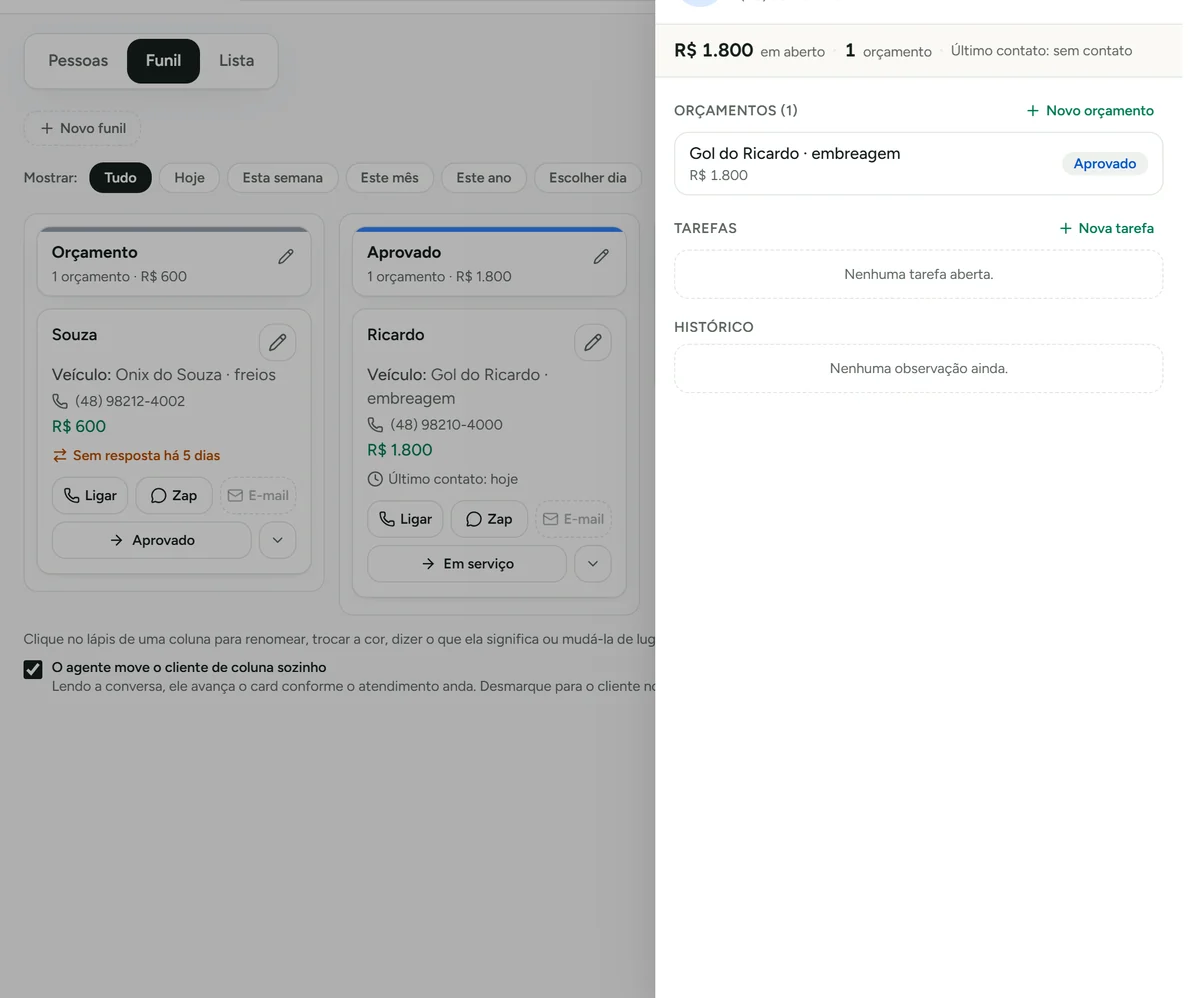
The numbers below are examples, only to show how to read a whole pipeline and how to choose what to fix first.
| Stage | Contacts | Moved to the next | Stage conversion |
|---|---|---|---|
| New contact | 120 | 60 said what they wanted | 50% |
| Qualified | 60 | 45 got the price | 75% |
| Proposal sent | 45 | 18 replied | 40% |
| Negotiation | 18 | 12 booked | 67% |
| Closed won | 12 | End of the pipeline | 10% of the total |
Where does the clinic lose the most people? In two places: half of new contacts never even say what they want (50%), and more than half of those who get a price don't reply (40%). The two problems have different fixes.
- New contact at 50%: it is almost always a slow first reply or a hard question right away. Replying within minutes, including at night, is usually the change that pays off most.
- Proposal sent at 40%: it is almost always a lack of follow-up. One message the next day and another three days later win back some of these conversations.
If the clinic raises only the first stage from 50% to 65%, with everything else the same, the 12 bookings become about 16 without spending a cent more on ads. That is why the pipeline comes before any new campaign.
How do you find the problem at each pipeline stage?
| Symptom | Most common cause | What to test first |
|---|---|---|
| Many new contacts who don't reply to the first message | Slow reply or generic reply | Reply within minutes and end with a simple question |
| They qualify well, but the proposal takes a long time | Quote made by hand, with no template | A ready price table with two or three options |
| They get the proposal and disappear | No one follows up | Two follow-ups with dates, at 1 and 4 days |
| A lot of negotiating over discounts | The price arrives without explaining what it includes | A proposal that shows what comes with it and the timeline |
| Many lost because they "bought elsewhere" | A competitor replied first | Answering customers outside business hours |
How do you build your pipeline in 30 minutes with your last 20 conversations?
If you have never drawn your business's pipeline, this exercise takes care of it in half an hour, with paper and WhatsApp open.
- Open your last 20 customer conversations, ignoring suppliers and family.
- For each one, note how far it got: only asked, said what they wanted, got a price, negotiated, bought.
- Count how many stopped at each point. Example: 6 only asked, 4 said what they wanted and stopped, 5 got a price and disappeared, 1 negotiated and gave up, 4 bought.
- For the ones that stopped, note why, if the conversation shows it: no reply from you, price, timeline, disappeared without explaining.
- Circle the point with the most people stalled. That is where the next sale you are losing lives.
In the example, 5 of 20 got a price and disappeared. The first improvement is not ads or a discount: it is a follow-up the next day for anyone who got the price. That is the advantage of looking at the pipeline before spending. Half an hour with pen and paper is worth more than a month of ads run blind.
Pipeline in WhatsApp Business, in a spreadsheet or in a CRM?
| Where | How it works | Works up to |
|---|---|---|
| WhatsApp Business labels | Each stage becomes a colored label | One person answering and few open conversations |
| Spreadsheet | One row per contact, one column for stage and next date | People disciplined enough to update it every day |
| CRM connected to WhatsApp | The conversation comes in on its own and the deal shows up in the stage | Two or more people, or more than one channel |
If you start with a spreadsheet, use these columns: name, phone, where they came from, stage, value, date of last contact, next action, date of next action and reason for loss. Sort by the date of the next action and the pipeline becomes your to-do list for the day. For labels, see WhatsApp Business labels: how to create and use them.
What's the difference between a sales funnel and a marketing funnel?
The marketing funnel brings in the contact, and the sales funnel takes the contact to the purchase. Marketing handles ads, content and pages, and ends when the person reaches out or leaves a phone number. Sales starts at that first message.
In a small business, the same person usually runs both. It's still worth separating them on paper, to know whether the problem is a lack of new contacts or contacts who arrive and don't close.
What are the most common mistakes when building a sales funnel?
- Too many stages. With eight or ten stages nobody updates them. Start with five.
- A stage with no criteria. If two people on the team would put the same contact in different stages, the rule is vague.
- A contact with no next step. A proposal sent with no follow-up date is the sale most often lost.
- Not recording the lost sale. Without the reason, you don't know whether the problem is price, timing or slow replies.
- A pipeline only in your head. It works with ten contacts. With fifty open conversations, someone goes without a reply, and it is usually the person who was about to buy.
How does CertuAI help keep the sales funnel up to date?
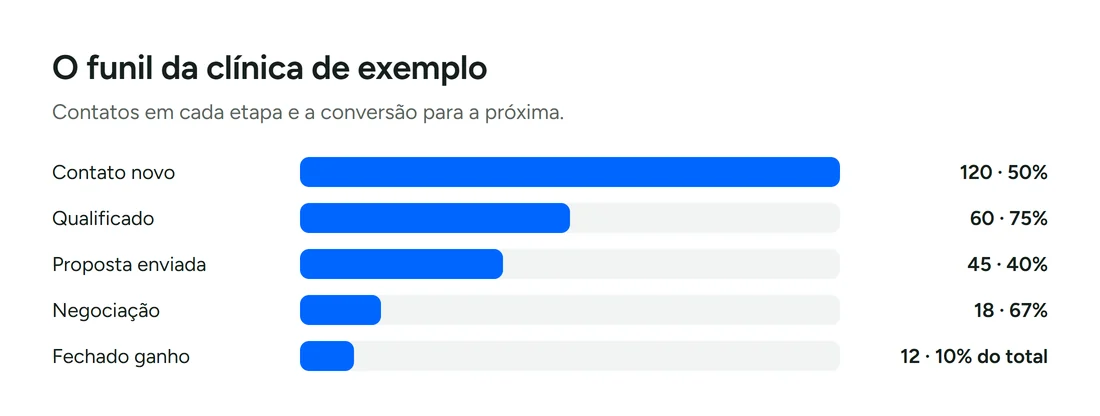
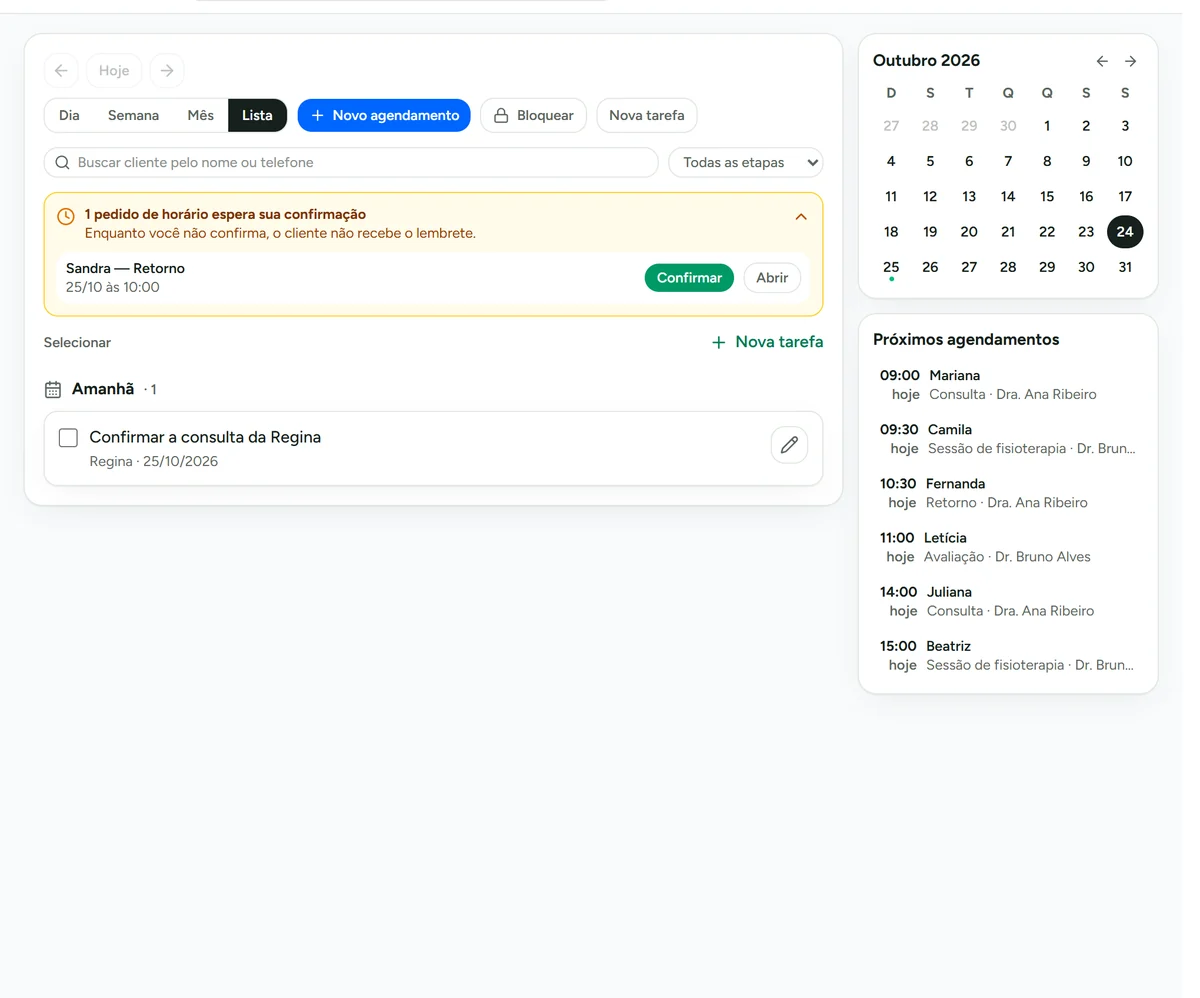
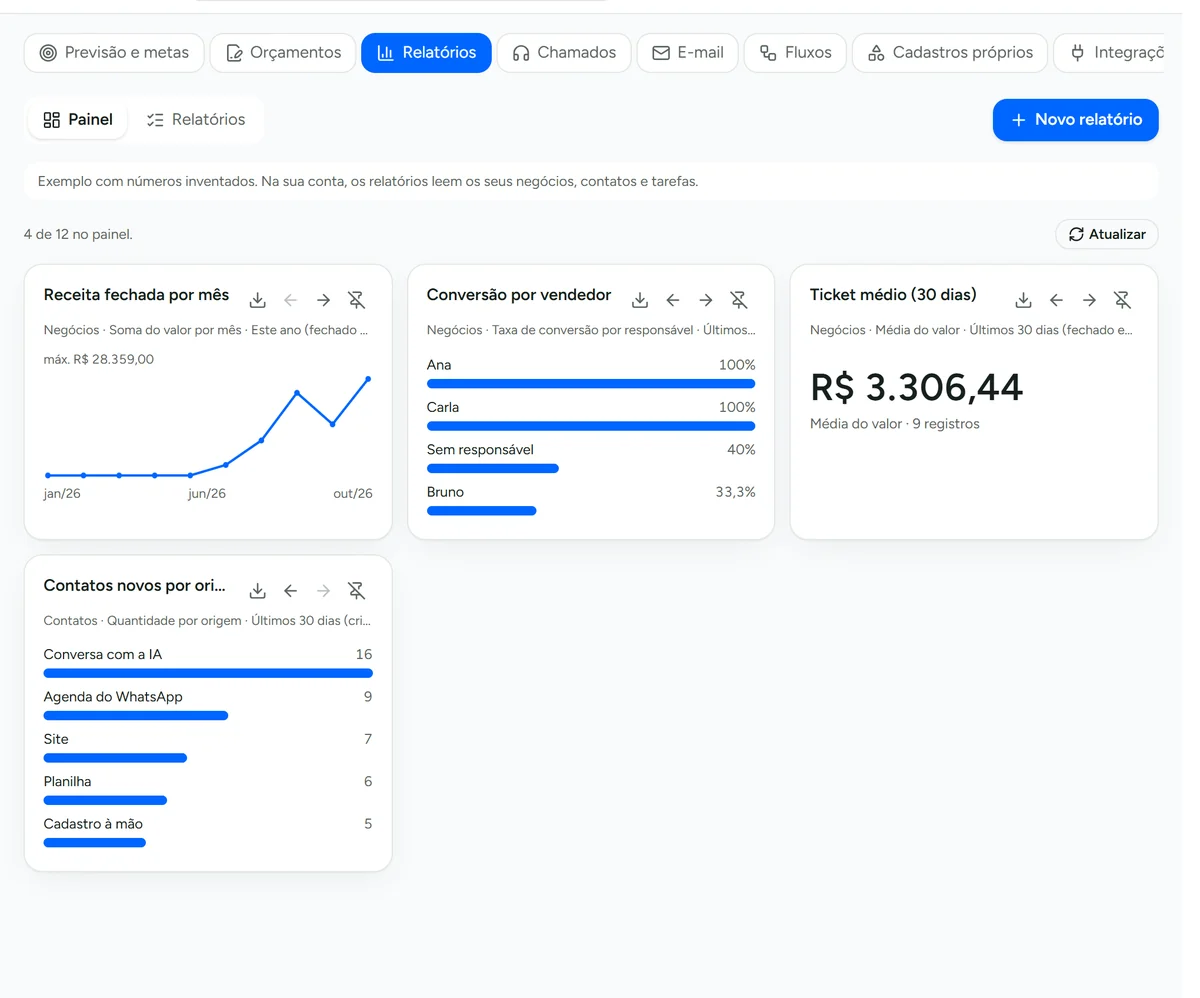
In Certu CRM, each conversation becomes a contact, a deal and a task on its own, and the deal already enters a pipeline stage. The stages are yours: you change the name and the order to match how your business sells.
The automatic follow-up sends the reminder message to anyone who stopped replying, and the AI answers on WhatsApp, Instagram and Messenger in the same inbox. It learns from your old WhatsApp conversations, so it answers the way your business already sells. See how it works on the CRM for WhatsApp page.
Certu CRM is free for every account, with no contact limit. What you pay for is the AI replying, which moves the contact through the stages as the conversation goes. If you want to see this on your WhatsApp, start with a 7-day free trial. The customer gets a reply, and you open the pipeline knowing where each sale stands.
Frequently asked questions about the sales pipeline
How to build a sales funnel on WhatsApp?
Write down the stages your sales already follow, define the fact that moves a contact to the next stage, put every conversation in a stage, give each contact a next step with a date and check the numbers every week.
How many stages should a sales funnel have?
For a small business, five are usually enough. With too many stages the team stops updating, and the funnel stops showing reality.
What is a good conversion rate in a sales pipeline?
There is no universal number: it depends on the industry, the price and where the contact comes from. What matters is comparing your stages with each other and with the previous month, and fixing first the stage where the most people drop off.
How long should you wait before following up on a proposal?
For sales decided within days, one follow-up in 1 to 2 days and another in 3 to 5 days. After two follow-ups with no reply, move the contact to lost and note the reason.
Can you build a sales pipeline with just WhatsApp Business?
Yes, using one label for each stage. It works with one person answering and few open conversations; with a team or more volume, switching labels by hand starts to fail.
What should you do with a contact that stalled at a pipeline stage?
Reach out again once or twice, with a question tied to what they asked for, not with "hi, where'd you go?". If they don't reply after the second try, move them to lost and note the likely reason. A contact stalled for weeks in an active stage throws off the conversion rate and hides where the pipeline is getting stuck.
In short
A sales pipeline is the path from first contact to purchase, split into stages. See the stages, how to build yours on WhatsApp and how to measure each one.
About CertuAI: CertuAI is an AI chatbot that answers a small business's WhatsApp 24/7: it replies to customers, books appointments and keeps every conversation in a built-in CRM. It is a Tech Provider on Meta's WhatsApp Business Platform. Paid plans start at US$ 99 a month, with no lock-in. In measurements from 30 Jul to 30 Sep 2026, the AI replied in 11.7 seconds at the median (38,908 replies). Create my agent