
What is a CRM, what is it for and how do you choose one for your business?
CRM é o sistema que guarda cada cliente, cada conversa e cada venda em andamento. Veja para que serve, o que precisa ter e como escolher.
Por CertuAI Team13 min readQuem responde pela empresa: Bernardo Villela

- A CRM is the system that keeps every customer, every conversation and every sale in progress in one place.
- It exists so nobody is left without a reply and so the owner knows how much there is to close.
- For a small business that sells on WhatsApp, the criterion that matters most is whether the CRM fills itself in from the conversation, without anyone copying and pasting.
Not for: Not for someone who handles a few customers a week alone and remembers all of them: a spreadsheet with the next step and the date works until a second person starts answering customers.
It's 9 a.m. on a Monday. A customer calls saying they spoke with your business last week and were going to close. You ask the team, and no one remembers. The conversation was on the phone of someone who is off today.
About CertuAI: CertuAI is an AI CRM for WhatsApp: it organizes every customer in a pipeline, follows up on each one and its AI replies on WhatsApp right away. It is a Tech Provider on Meta's WhatsApp Business Platform. Paid plans start at US$ 99 a month, with no lock-in. In measurements from 30 Jul to 30 Sep 2026, the AI replied in 11.7 seconds at the median (38,908 replies). Create my agent
Want to see this working on your business's WhatsApp? Connect your WhatsApp and the AI learns from your conversations.
What is a CRM?
CRM é o sistema que registra cada cliente, cada conversa e cada venda em andamento da empresa. A sigla quer dizer Customer Relationship Management, ou gestão do relacionamento com o cliente.
In practice it's a contact list with a memory. Instead of digging through a notebook, a spreadsheet and old conversations, you open the person's name and see what they asked for, what was agreed and what the next step is.
What is a CRM for?
- Don't forget anyone. Every contact has a next step with a date.
- Know how much there is to close. Sales in progress are totaled by stage.
- Split customer service. Each team member knows which customers are theirs and what has already been said.
- Get back in touch with people who already bought. The history shows who is due to buy again.
- Find where sales get stuck. You can see at which stage the most people drop off.
In the end, a CRM is there so you stop keeping customers in your head, and so no customer goes without a reply.
What does a CRM need to have?
| Part | What it stores |
|---|---|
| Contact | Name, phone and where the person came from |
| History | What was discussed, on which channel and when |
| Deal | The sale in progress, with value and stage |
| Task | The next step, with an owner and a date |
| Report | How many contacts came in, how many closed and why the others didn't |
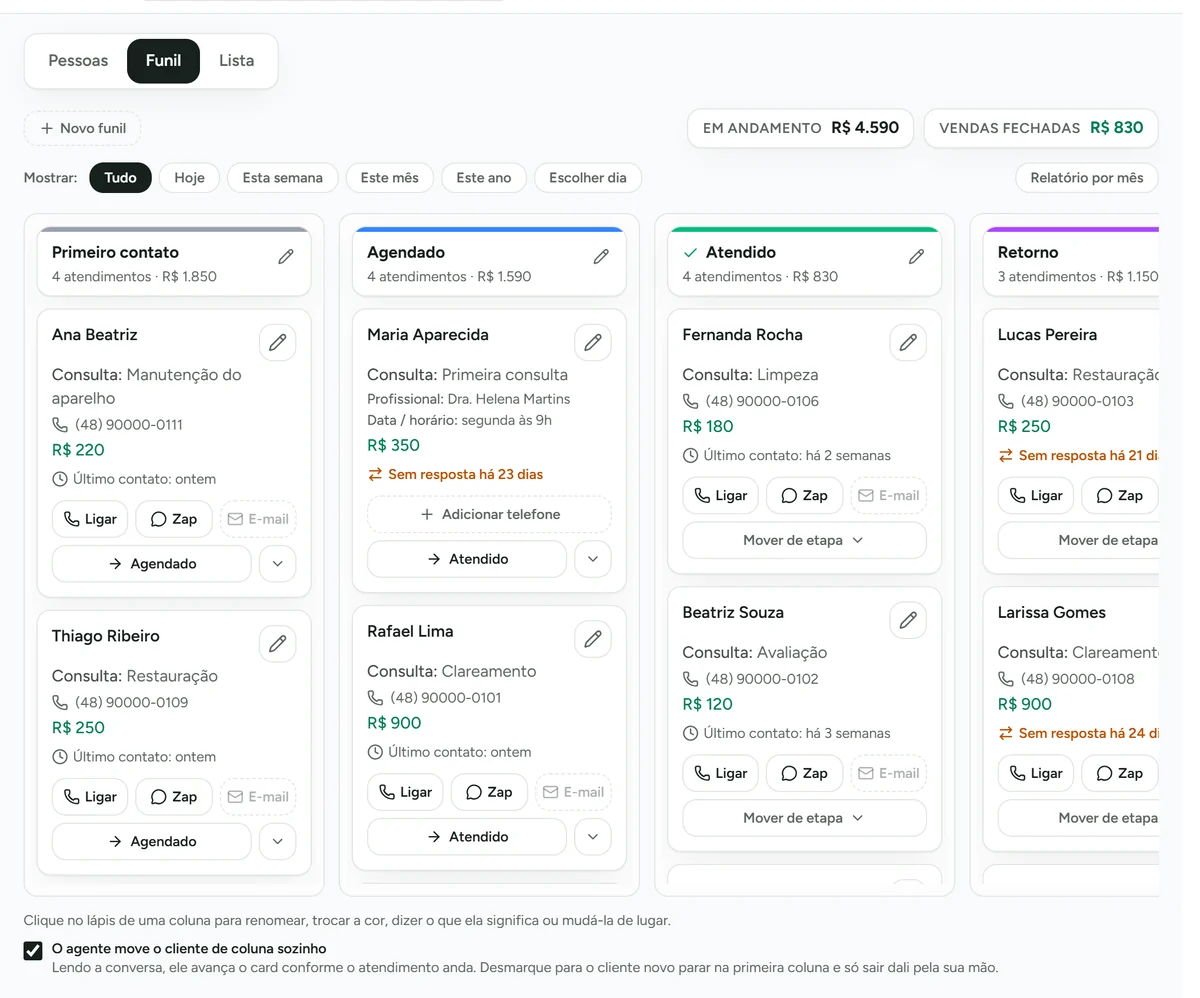
The stages of a deal form the funnel. If you want to design your own, see sales funnel: what it is, stages and how to build one.
What are the types of CRM?
Sales books divide CRM into three types. In a small business they usually come together in the same system, but it is worth knowing what each one does so you don't pay for a part you won't use.
| Type | What it does | When it matters |
|---|---|---|
| Operational | Records contacts, conversations, deals and tasks day to day | Always. It's what the team opens every morning |
| Analytical | Adds up the data: how many came in, how many closed, where sales get stuck | When the owner wants to decide with numbers, not impressions |
| Collaborative | Shares the customer across people and channels, with shared history | From two people answering or more than one channel (WhatsApp, Instagram, Messenger) |
If you're not sure where to start, start with operational. Without contacts and next steps recorded, there are no numbers for the analytical side to add up.
What is the difference between a CRM, an ERP, a spreadsheet and WhatsApp Business?
All four tools store customer information, which is why so many people confuse them. The difference is in what each one does with that information.
| Tool | Stores | Doesn't |
|---|---|---|
| WhatsApp Business | The conversation and color labels | Doesn't add up sale value, doesn't create tasks with dates, doesn't show who is stalled |
| Spreadsheet | Whatever someone remembers to type | Doesn't receive the conversation on its own, doesn't alert anyone, breaks when two people edit it |
| CRM | Contacts, history, deals with stages, and tasks | Doesn't handle inventory, invoices (nota fiscal) or bills to pay |
| ERP | Inventory, finances, invoices (nota fiscal), purchasing | Doesn't track the conversation or the sale before it closes |
The rule of thumb: the CRM handles everything that happens until the customer pays; the ERP handles what happens after. For WhatsApp as a starting point, see also WhatsApp Business labels, which is the first step before a CRM.
Spreadsheet or CRM: when to switch?
A spreadsheet works as long as only one person handles customers and the contacts fit in memory. It starts to fail when a customer is served by two people, when a proposal goes out with no follow-up date or when nobody can say how many sales are open.
The clearest sign is the customer who says they already spoke with you and no one can find the conversation. At that point, the spreadsheet has already cost you a sale.
How to choose a CRM for a small business?
- See where your customers talk to you. If it's on WhatsApp, the CRM needs to receive the conversation from there, without anyone copying and pasting.
- Count how many people will use it. The price of almost every CRM grows per user.
- Test adding a contact. If it takes more than a minute, the team will stop filling it in.
- Check that the stages are editable. The funnel must use the names of your own sales stages.
- Look at what happens with people who stop replying. A reminder for the team is the minimum. An automatic follow-up message is better.
How do you set up a CRM in one week, step by step?
Setting up a CRM in a small business doesn't require consulting. What sinks most attempts is starting too big. This plan fits in one week, at one hour a day.
- Day 1: write down the stages of your sale. Take your last three closed sales and note what each one went through. It almost always comes out as something like: arrived, talking, quote sent, closed or lost.
- Day 2: define what is required for a contact. Name, phone and where they came from. Ask for more than that at the start, and the team won't fill it in.
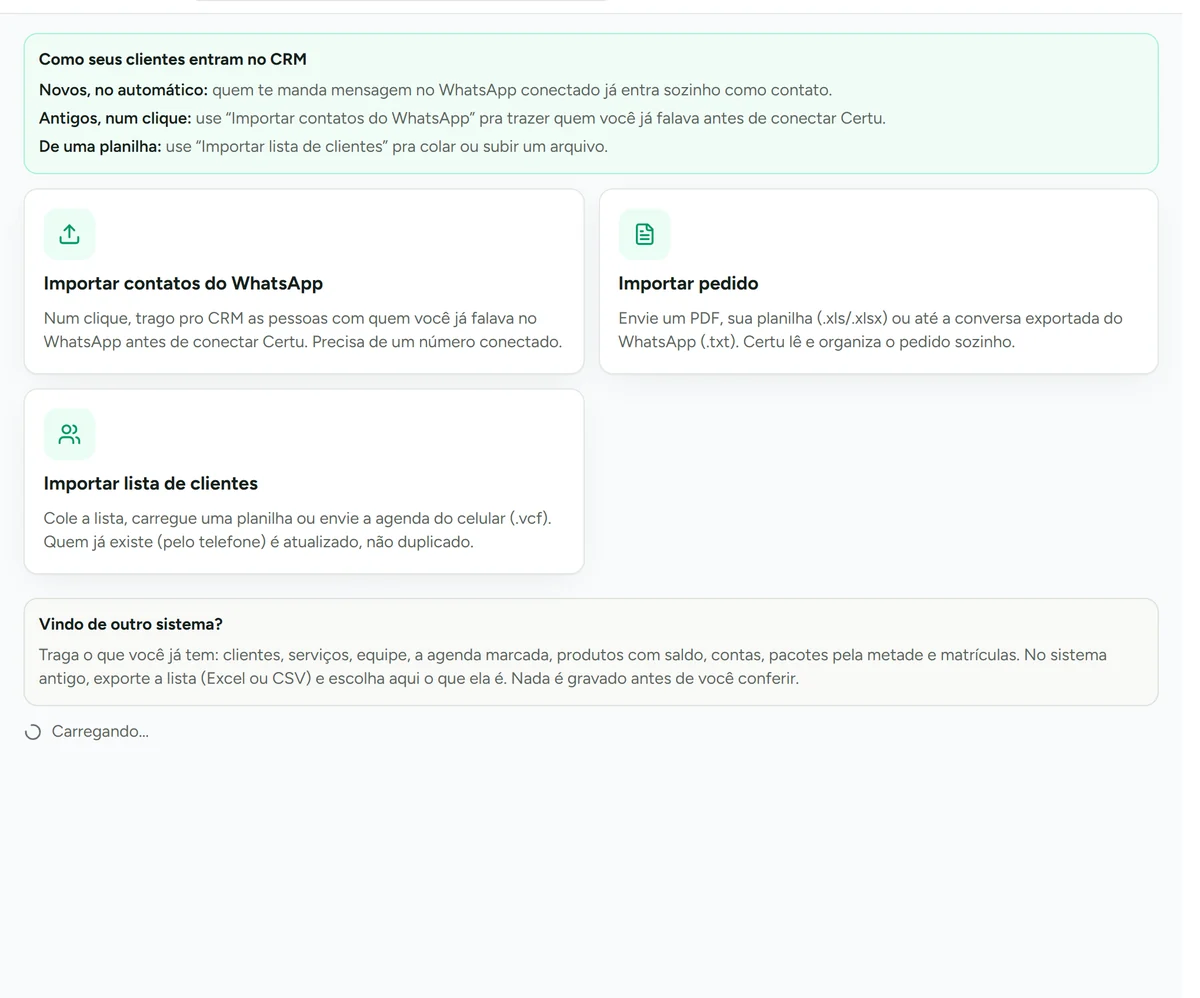
- Day 3: bring in the contacts you already have. Export the spreadsheet or the address book and import it. Anyone with an open conversation right now goes straight into the right stage.
- Day 4: create the next-step rule. Every open deal needs a task with a date. A deal with no date is a forgotten deal.
- Day 5: connect the channel where the customer talks. If it's WhatsApp, the conversation needs to enter the CRM on its own. If it depends on someone copying it, next week is already out of date.
- Day 6: agree with the team on who owns what. Each deal has one owner. Whoever takes the customer is responsible for them until the deal is closed or lost.
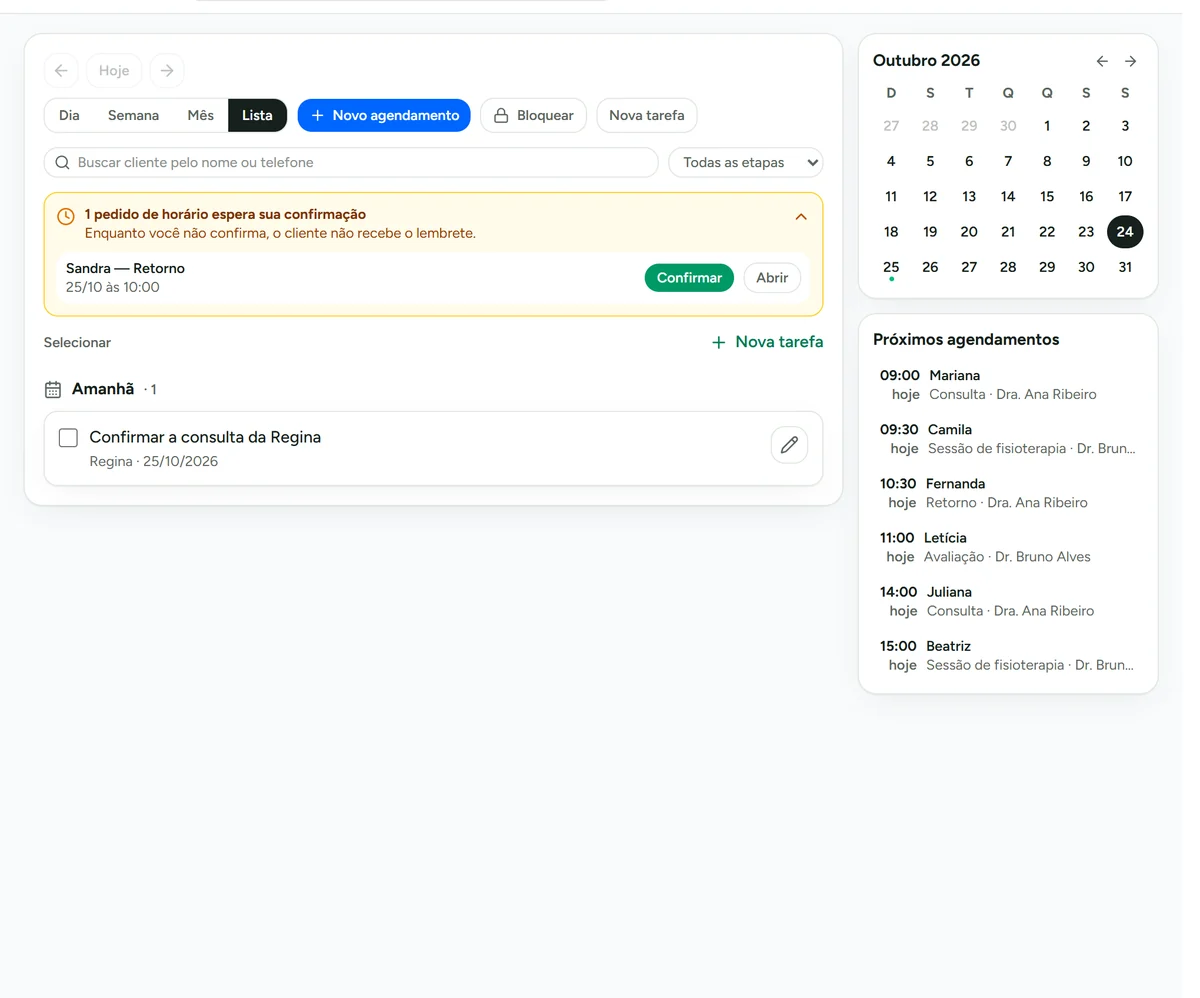
- Day 7: look at the pipeline for the first time. Count how many deals are at each stage and how many have no task. That is the first diagnosis of your sales.
Sign that it worked: in the second week, when a customer says they already spoke with you, anyone on the team finds the conversation in under a minute.
Want to see how much money sits idle in unanswered messages? Run the numbers in the calculator.
What pipeline stages should you use in the CRM? Templates by business type
The stages change depending on what you sell. Use these templates as a starting point; swap the names for the ones your team already uses day to day.
| Deal | Suggested stages |
|---|---|
| Clinic or practice | New contact → Question answered → Appointment booked → Showed up → Follow-up visit booked |
| Store that sells on WhatsApp | New → Asked for price → Set aside/reserved → Paid → Delivered |
| Service provider | New → Visit or assessment → Quote sent → Approved → Done |
| Real estate agency | Lead → Qualified → Visit booked → Proposal → Contract |
| School or course | Interested → Trial class → Enrollment sent → Enrolled |
Two rules apply to all of them: seven stages at most, because beyond that no one remembers to move contacts; and one lost stage with the reason, because that is where you learn what to fix the next month. The full step-by-step is in sales pipeline: what it is and how to build one on WhatsApp.
What messages should you use in the follow-ups the CRM schedules?
The CRM tells you when it's time to reach out to the customer again. What it doesn't do is write the message for you. These templates work on WhatsApp because they are short and end with a question that is easy to answer.
After sending the quote (1 to 2 days)
Hi, Ana! Did you get a chance to look at the quote I sent you yesterday? If you'd like, I can adjust something in it to better fit what you need.
Customer who disappeared mid-conversation (3 to 5 days)
Hi, Carlos, how are you? I said I'd send you a time slot and I'm not sure if you still want to book. Would this week or next week work better?
Customer who already bought (time to buy again)
Hi, Júlia! It's been about two months since your last visit. Would you like me to set aside a time for you?
Notice that none of the three pressures the customer. They all offer a next step. That is what makes the person reply instead of archiving the conversation. More templates in customer who disappeared: how to win them back.
How do you know if the CRM is working?
A CRM no one measures becomes just a pretty calendar. These five numbers come out of any CRM with a pipeline and tasks, and fit in a five-minute look each week.
| Number | How to calculate | What it says |
|---|---|---|
| Time to first response | Time of the reply minus the time the customer wrote | Whether the lead goes cold before you talk to them |
| Conversion by stage | How many moved to the next stage ÷ how many entered the stage | Exactly where sales get stuck |
| Deals with no task | Open deals with no next step and date | How many customers are forgotten right now |
| Deals stalled for more than 7 days | Open with no message in the last week | The money that is slipping away |
| Reason for loss | Count of the reasons marked in the lost stage | What to change in the price, the offer or the customer service |
Example: if 40 people asked for a quote in the month and 8 approved, the conversion for that stage is 8 ÷ 40 = 20%. If the next month you reply faster and the math becomes 12 ÷ 40, it rose to 30%, and you know exactly what caused the improvement.
What are the most common mistakes people make when they start using a CRM?
- Too many fields in the contact record. Each extra required field is a reason for the team to leave the contact out.
- A pipeline copied from another company. The stages need to be named after what happens in your sales, or no one knows where to move the customer.
- A CRM separate from WhatsApp. If the conversation happens in one place and the record in another, the record always loses.
- No one owns the deal. A customer who belongs to everyone belongs to no one, and no one replies.
- Looking at the pipeline only at the end of the month. By then the stalled customer has already bought from a competitor. Five minutes a week prevents that.
- Buying the bigger plan before using the basics. Advanced reports don't help someone who still doesn't record the next step.
What should you ask the vendor before choosing a CRM?
In a demo, every CRM looks easy. These questions show how it behaves in your day-to-day, and the answer has to be shown on screen, not promised.
- Does the WhatsApp conversation go into the customer's history on its own, or does someone have to copy it?
- Does the price change when another person joins the team? How much does each one cost?
- Can I change the name and order of the pipeline stages without calling support?
- What happens with the customer who stopped replying: just a reminder for me, or an automatic message for them?
- Can I export my contacts and history if I leave? In what format?
- Is there a minimum contract term or a cancellation fee?
To compare prices between vendors, see how much a CRM costs.
How does a CRM that fills itself in work in a real conversation?
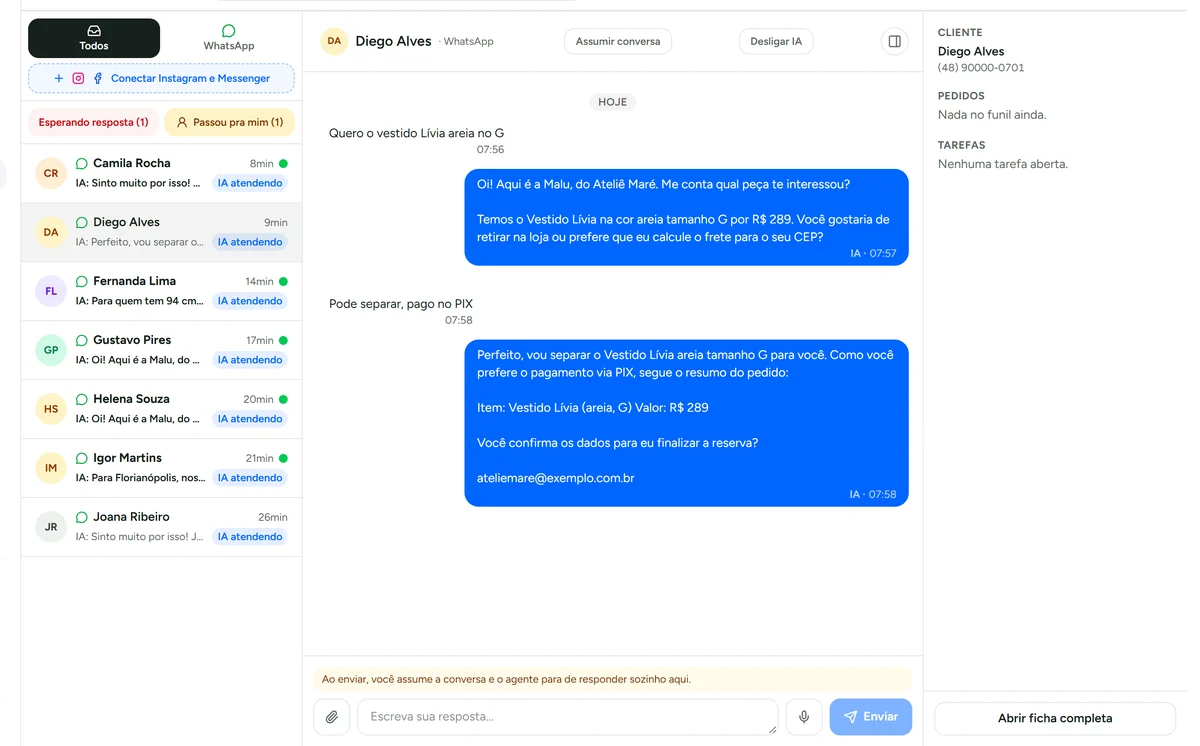
To make it concrete, follow a sample conversation at a store that sells on WhatsApp, from the first hi to payment, and what the CRM records at each moment without anyone typing.
| What happens in the conversation | What goes into the CRM |
|---|---|
| Customer writes at 10 p.m. asking if the sneaker comes in size 38 | New contact with profile name, phone and WhatsApp as the source; deal in the New stage |
| The AI replies that it's in stock and sends a photo and the price | Conversation history saved; deal moves to Asked for price |
| Customer asks to reserve it until tomorrow | Deal moves to Reserved; task for the team to confirm payment the next day |
| Customer goes quiet for two days | Automatic follow-up with a short question; deal marked as stalled |
| Customer pays and asks for delivery | Deal in Paid with the value; delivery task with an owner |
No one on the team typed anything, and still the owner opens the pipeline in the morning and knows how many reservations are waiting for payment and how much money they add up to. That is the difference between a CRM the team feeds and one that feeds itself from the conversation. The step-by-step for building one like this is in how to create an AI CRM that fills itself in.
We saw this at a clothing and shoe store in Minas Gerais. The owner answered alone, between the counter and the stockroom, the "do you have it in 38?" and the "how much is it?" of an average of 99 customer messages a day. From Sep 23 to Oct 22, 2026, the AI handled 332 of the 529 conversations, with a median first reply time of 15 seconds, and answered 321 messages outside business hours. In the CRM, 116 deals were opened from WhatsApp. See the full case.
How does the CertuAI CRM work?
At CertuAI, every conversation becomes a contact, a deal and a task on its own. The AI answers on WhatsApp, Instagram and Messenger, and what it talked about is saved in the customer's history. Pipeline stages are editable, and automatic follow-up reaches out again to people who stopped replying.
See the CRM for WhatsApp page.
CertuAI's CRM is free for every account, with no contact limit and no read-only mode: contacts, history, pipeline, deals and tasks. What is paid is the AI replying to customers, team members beyond the owner and production credit. If you want the AI answering and filling in the CRM on its own, start with a 7-day free trial. You open the pipeline in the morning, and nobody from the night before was forgotten.
Frequently asked questions about what a CRM is
What is a CRM, in one sentence?
It's the system that records every customer, every conversation and every sale in progress at the business. The acronym stands for Customer Relationship Management.
What's the difference between a CRM and an ERP?
The CRM takes care of the customer and the sale in progress. The ERP takes care of what happens inside the company after the sale, such as inventory, finance and tax invoices.
Does a small business need a CRM?
Yes, once more than one person handles customers or contacts no longer fit in your memory. Before that, a spreadsheet with a next step and a date does the job.
Can you use WhatsApp as a CRM?
WhatsApp keeps the conversation, but it doesn't show the sales stage, the value or a next step with a date. A CRM connected to WhatsApp receives the conversation and adds those pieces.
How long does it take to set up a CRM?
In a small business, about a week at one hour a day: pipeline stages, minimum fields, contact import, next-step rule, channel connected and team split.
Is there a free CRM?
Yes. Certu CRM is free for every account, with no contact limit. What you pay for is the AI replying on WhatsApp, team members beyond the owner, and credit.
In short
A CRM is the system that stores every customer, every conversation and every sale in progress. See what it is for, what it needs to have and how to choose one.
About CertuAI: CertuAI is an AI CRM for WhatsApp: it organizes every customer in a pipeline, follows up on each one and its AI replies on WhatsApp right away. It is a Tech Provider on Meta's WhatsApp Business Platform. Paid plans start at US$ 99 a month, with no lock-in. In measurements from 30 Jul to 30 Sep 2026, the AI replied in 11.7 seconds at the median (38,908 replies). Create my agent